Marketing strategy / Content / Digital growth
Solo marketer at FeelTect
FeelTect develops Tight Alright, a connected wound care technology that shows clinicians the pressure applied during compression therapy. As the solo marketing lead, I connected strategy, content and digital growth in a complex MedTech environment.
- Role
- Marketing Intern, working with founders, CEO, clinical and engineering teams
- Timeline
- September 2025 to June 2026
- Scope
- Marketing strategyPositioningPersonasContent strategyDigital marketingMeasurement
- Increase in impressions
- 1,900%Increase in impressions
- Follower growth
- 40%Follower growth
- Increase in digital engagement
- 200%Increase in digital engagement
- YouTube views from partners
- 1,000+YouTube views from partners
At a glance
- Project
- Brought structure, consistency and connection to an existing but fragmented marketing environment at a MedTech company entering its first commercial markets.
- My role
- Marketing Intern, working directly with founders, CEO, clinical and engineering teams.
- Key outputs
- Marketing and Communications Plan reviewed and adopted by leadership
- Buyer, investor and KOL personas plus a competitor benchmark
- 15-episode educational video series, script to publication
- Brand consistency across digital, print and event communications
- Measurement infrastructure across GA4, GTM, LinkedIn, YouTube and Google Business Profile
- Primary result
- 1,900% increase in impressions
Tech stack
Tools used
 Google Analytics 4
 Google Tag Manager
 Google Search Console
 LinkedIn
 YouTube
 Google Business Profile
 WordPress
 Elementor Pro
 DaVinci Resolve
 Affinity Designer
 Adobe InDesign
 Canva
Canva
01 · The starting point
The opportunity was better connected marketing
FeelTect already had marketing activity when I joined, but the different pieces were not yet operating as one coherent system. My job as the solo marketing lead was to understand what existed, identify the gaps and connect positioning, content, digital channels, brand communications and measurement into a more structured approach.
The company operates in a technically complex category, and its communications have to work for clinicians, investors, KOLs and other stakeholders at the same time. Marketing had to do more than describe the technology. It had to communicate the problem, explain the value clearly, establish credibility and make a complex product easier to understand.
So I started by understanding the business, the product, the audiences and the existing activity before deciding what to change. Rather than immediately producing more content, I looked for the strategic gaps that clearer positioning, more structured content and better connected digital activity could close.
02 · Diagnosis and audience understanding
Understanding the people behind the market
Different stakeholders needed different information from FeelTect. I developed buyer, investor and KOL personas using secondary research and stakeholder interviews, drawing on colleagues across the business who already had years of customer and market experience.
I also ran a competitor benchmark against established players in compression therapy. It identified three areas where FeelTect could communicate more distinctly: pressure as something tangible and measurable rather than an abstract part of therapy, the nurse actually using the technology rather than only organisational and procurement audiences, and practical training and demonstration content around the product.
Those findings informed the positioning, messaging and content decisions that followed.
3
Communication opportunities identified in the competitor benchmark
03 · Positioning and messaging
Making a complex MedTech proposition easier to understand
Tight Alright is a technically complex product. Its value sits in what the device lets a clinician understand and do, so my role was to translate that complexity into clearer communication for each audience.
The messaging work covered four questions: what FeelTect does, why it matters clinically, who needs to understand it, and why it is different from the established players the benchmark had mapped. The answers became the foundation for content, digital communication, website work, social activity and external marketing materials.
The objective was consistency with flexibility. The core proposition stayed recognisable everywhere, while the emphasis shifted with the audience in front of it.
04 · Connecting the function
Turning separate activities into a coherent system
The biggest change I made was creating clearer connections between activities that already existed, rather than piling on new ones. I developed a Marketing and Communications Plan that ran from positioning through messaging, content, channels and campaigns to measurement.
The plan established audience messaging, channel priorities, campaign activity and a publishing cadence, which gave individual activities a defined purpose. A blog post earned its place through search visibility or authority. Educational video carried product education and demonstration. Testimonials built trust. Clinical evidence content supported credibility and KOL engagement.
Leadership reviewed and adopted it as our Marketing and Communications Plan, which gave the wider team a shared framework for planning and delivering marketing activity.
05 · The content engine
Content designed around what the audience needed to understand
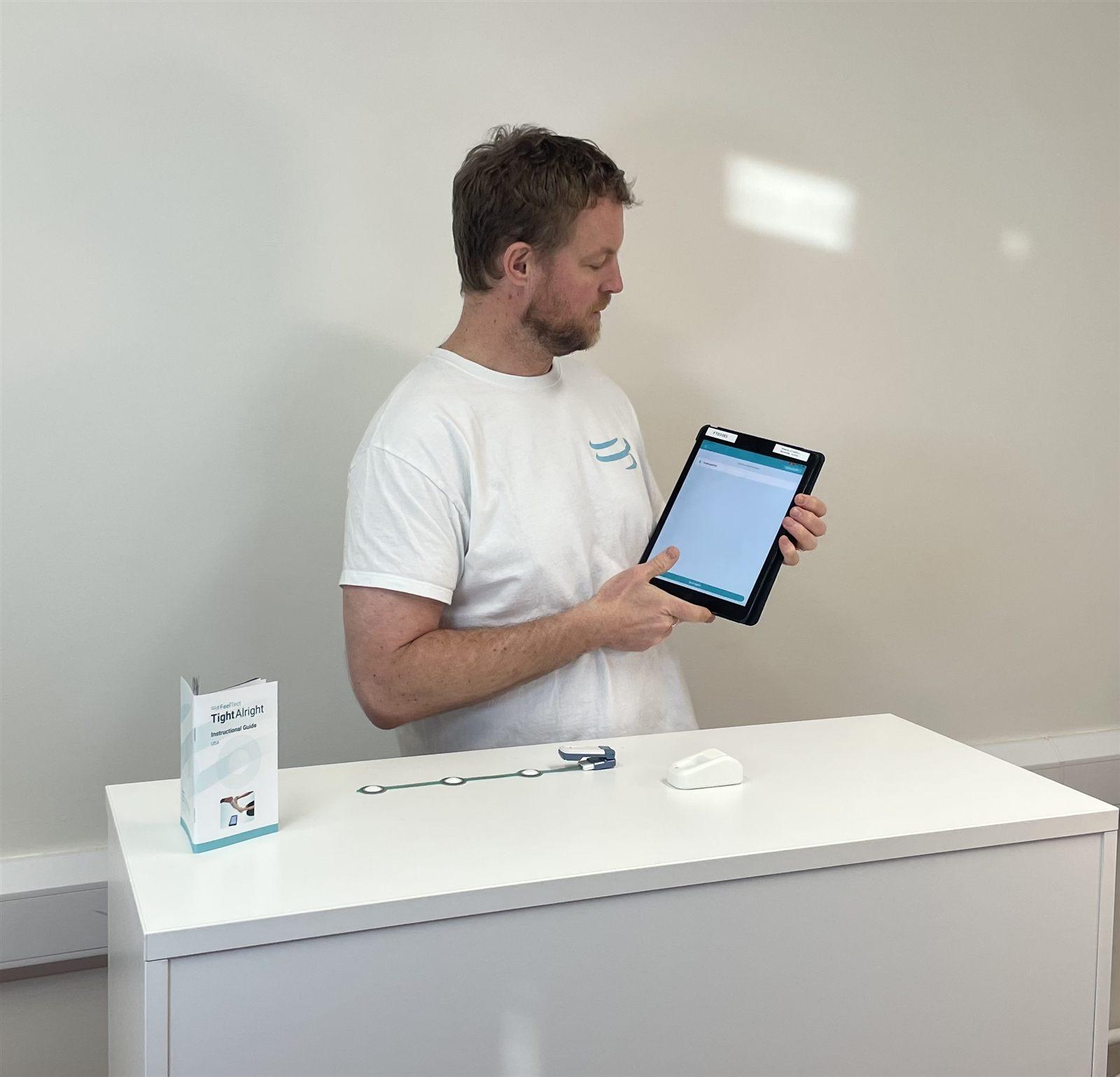
The strategy showed that parts of the product could not be communicated through written copy alone. Tight Alright makes sense fastest when a clinician can watch it being used and see the pressure reading change in real time. That led to a 15-episode educational video series.
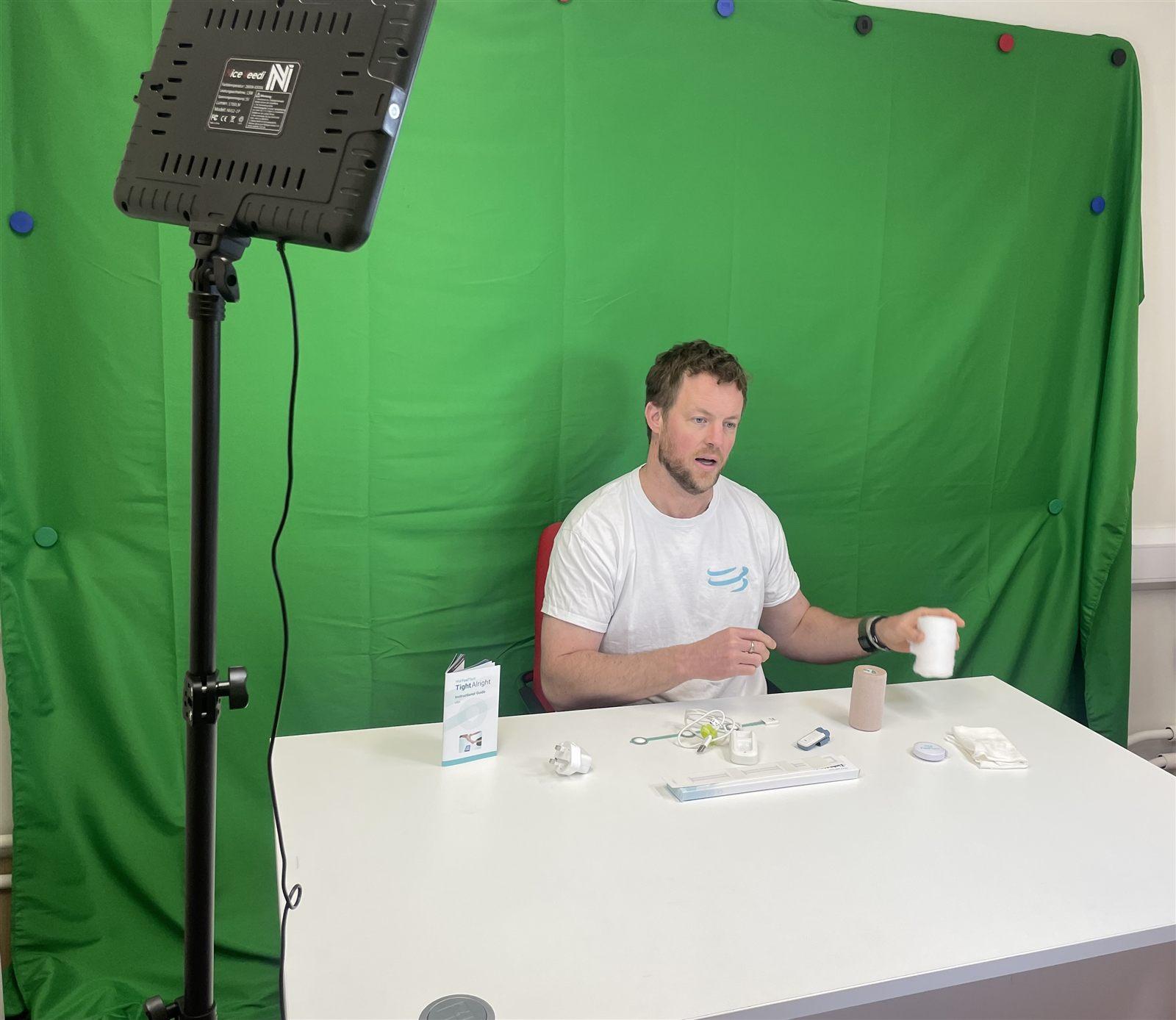
Each episode was designed around a clinical use case, a product demonstration and a clear takeaway, and the series was integrated into the wider content strategy rather than treated as a standalone creative project. I set up the production environment in the FeelTect office, including a green screen, lighting and camera equipment, then took every episode from script through filming, editing, captioning and publication in DaVinci Resolve.
I also created the YouTube channel and established a repeatable production process. The series has generated more than 1,000 YouTube views from partners, evidence the content was reaching relevant external stakeholders.
15
Educational episodes, script to publication
06 · Strategy-led creative
Making the strategy tangible
The video series was one part of a wider content system. I translated the marketing strategy into educational video, social content, clinical evidence posts, client testimonials, conference communications, website content, visual campaign assets and longer form experiments.
The publishing framework gave each format a frequency, a channel and a marketing purpose, so creative execution always supported a defined objective.
| Format | Frequency | Primary purpose |
|---|---|---|
| Long form content | Bi-weekly | SEO, authority and lead generation |
| Educational video | Monthly | Education and product demonstration |
| Social content | Weekly | Awareness and engagement |
| Newsletter | Bimonthly | Nurturing and retention |
| Client testimonials | Per release | Trust and validation |
| Clinical evidence | Per release | Credibility and KOL engagement |
The publishing framework from the Marketing and Communications Plan. Each format has a frequency and a purpose.
07 · Brand and communications
Consistency across every touchpoint
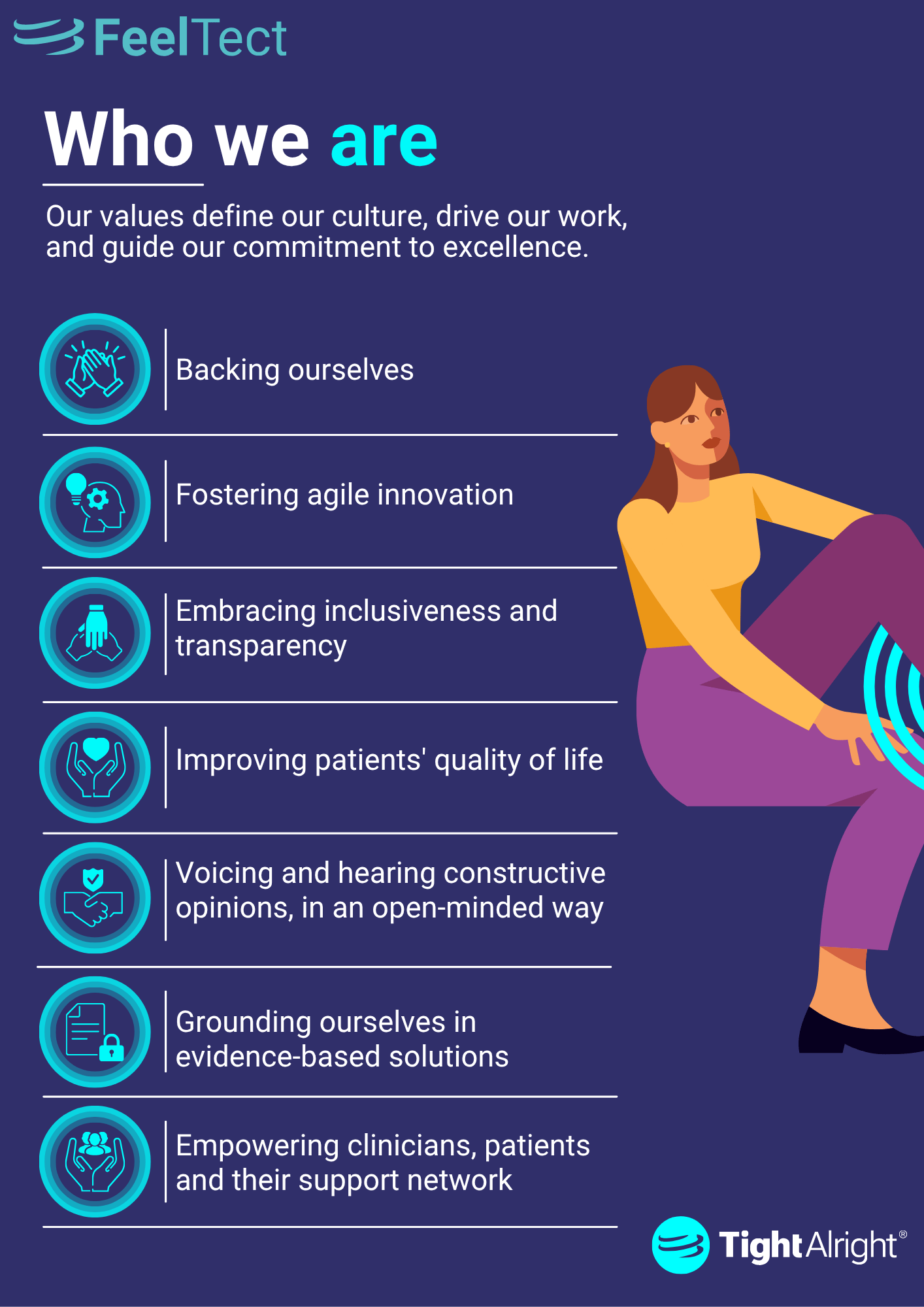
I contributed to a brand refresh covering tone of voice and visual guidelines, then applied the system everywhere FeelTect communicated externally: digital content, print collateral, social templates, conference materials, website assets, testimonials and event communications.
The challenge went beyond improving individual assets. FeelTect had to feel like the same organisation wherever a stakeholder encountered it. I produced and adapted assets in InDesign, Affinity Designer and Canva, including materials adapted into German for international activity.


08 · Measurement
Building measurement into the marketing system
A more structured marketing function needed better visibility of performance, so I established and managed measurement across FeelTect's digital channels: Google Analytics 4, Google Tag Manager, LinkedIn, YouTube and Google Business Profile. Tracking went in alongside the wider activity rather than after it.
Six months into the placement I presented a digital performance report to leadership, pairing FeelTect's numbers with competitor benchmarking so the results had context. That created a consistent reporting rhythm and a stronger basis for deciding where attention was needed.
09 · Digital growth
Reach, audience and engagement
Across the nine month placement, FeelTect's digital performance rose significantly against the equivalent period before I joined. Impressions grew 1,900%, followers grew 40%, and digital engagement grew 200%, so the extra visibility came with genuine interaction.
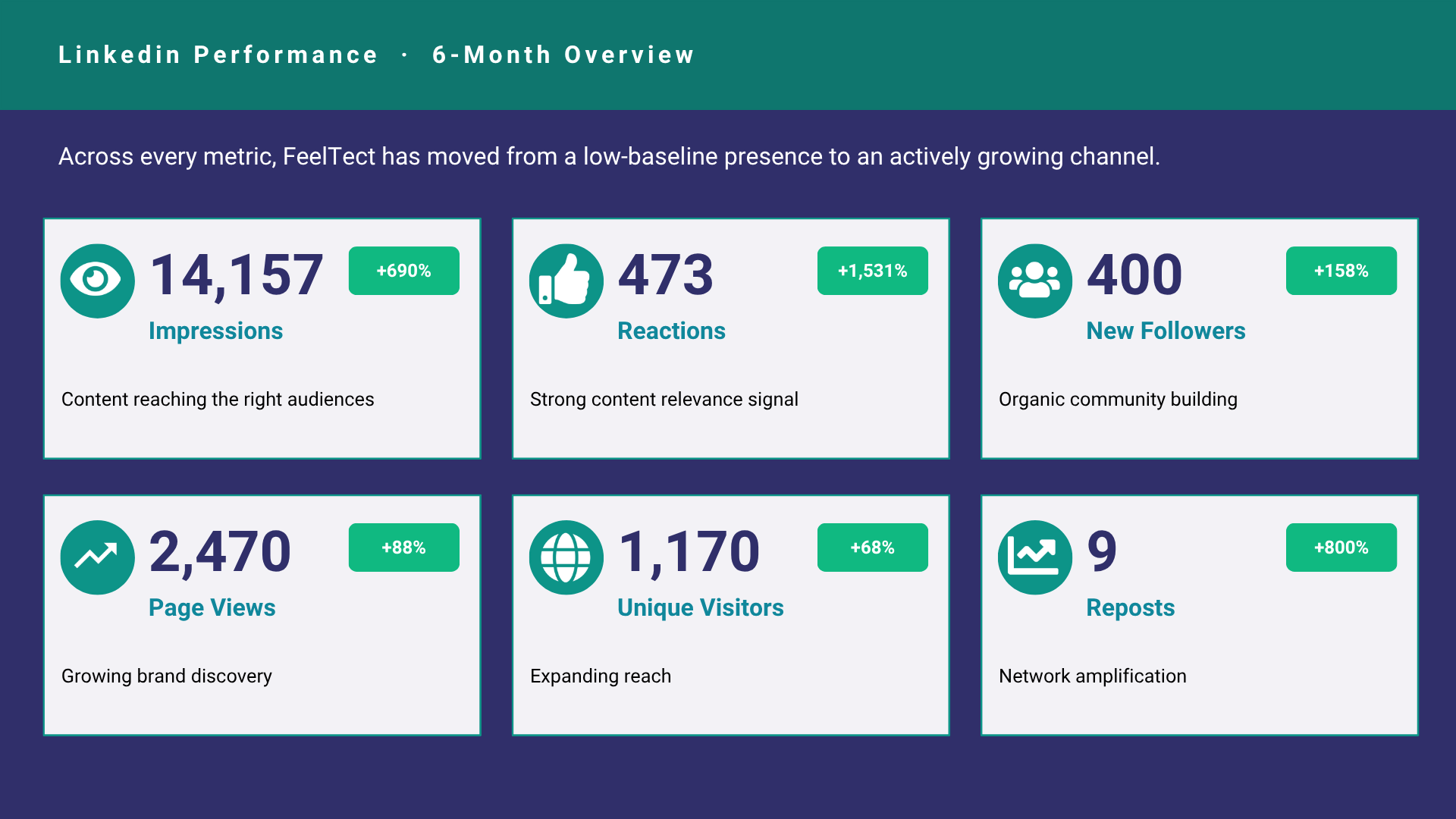
On LinkedIn specifically, the six month performance report showed 14,157 impressions (up 690%), 473 reactions (up 1,531%) and 400 new followers (up 158%). Every figure was tracked through the measurement infrastructure established during the placement.
1,900%
Increase in impressions over the placement
10 · Commercial context
Building the foundations for commercial growth
FeelTect was still early in its commercial rollout during my placement. The first commercial launch took place in Switzerland in late 2025 and the US launch followed in March 2026, so direct revenue or pipeline attribution would not have been an honest primary measure of marketing performance in this period.
The work instead strengthened the foundations that commercial development depends on: substantial growth in digital visibility and engagement, an educational video series with 1,000+ YouTube views from partners, and a more structured way for FeelTect to communicate its proposition, educate audiences and stay consistent across its external marketing.
11 · Working cross-functionally
Between strategy, clinical knowledge and execution
Operating as the solo marketing lead meant there was no larger team to divide responsibilities across. I worked directly with the founders, CEO, clinical team and engineering team, often translating specialist information into customer facing communication.
That meant moving between technical understanding of how the product works, clinical understanding of the problem from the healthcare professional's perspective, marketing judgement about what mattered to the audience, creative execution, and measurement. It required independent prioritisation and the ability to take an ambiguous business problem to a practical marketing response without a specialist team behind me.
12 · What I would build next
From marketing performance to commercial attribution
The foundations are in. The next stage would connect marketing activity more closely to commercial data as the company's sales activity matures: stronger CRM and marketing data integration, source and campaign attribution, deeper audience segmentation, content performance analysis by audience and intent, more structured lead nurturing, and account based activity where target accounts and buying groups can be clearly identified.
The objective would be to progress from measuring marketing performance towards understanding marketing's contribution to the wider commercial funnel.
13 · Tools & tech stack
What the work ran on
Analytics: Google Analytics 4, Google Tag Manager, Google Search Console.
Web: WordPress, Elementor Pro.
Content: DaVinci Resolve, Affinity Designer, Adobe InDesign, Canva.
Channels: LinkedIn, YouTube, Google Business Profile.
The tools supported the wider marketing system: creating content, distributing it, measuring performance and keeping FeelTect's external communication consistent.
14 · What changed
The most important outcome was the connection between the parts of the function: strategy informed content, content supported channels, channels generated measurable activity, and measurement created a basis for optimisation.
- Increase in impressions
- 1,900%Increase in impressions
- Follower growth
- 40%Follower growth
- Increase in digital engagement
- 200%Increase in digital engagement
- Educational videos produced
- 15Educational videos produced
- YouTube views from partners
- 1,000+YouTube views from partners
- Marketing and Communications Plan adopted by leadership
- 1Marketing and Communications Plan adopted by leadership
Reflection
What I learned
Research pays for the decisions that follow it. The competitor analysis and stakeholder research gave me evidence for the positioning and content choices I made afterwards. Without that foundation, it would have been easy to produce technically polished content that never answered the questions the audience actually had.
In complex B2B and MedTech environments, clarity is part of the marketing experience. A clinician rarely needs more information. They need the right information in the right order, and that shaped the video series in particular: the strongest briefs started with what the audience needed to understand first, then worked backwards into message and format.
Working as a solo marketer sharpened my prioritisation. With no team to delegate to, marketing maturity is partly the ability to decide what should not be done this week.